Monday, 10 April 2017

Josef Frank-Patterns-Furniture-Painting

Josef Frank (1885-1967)

I hadn't visited the Fashion and Textile Museum before, despite making many visits to White Cube just a stone's throw away. I was very much looking forward to a visit in 2017 though, having eagerly anticipated this Josef Frank exhibition. I only discovered his fantastic work early last year, and was then coincidentally commissioned to create a 1 metre square Butterfly Ball based on the colours of his Citrus Fruit textile design later in the year (here).


The Fashion and Textile museum - the brainchild of textile designer Zandra Rhodes - is a little gem, and the ideal place for a Josef Frank retrospective.


There is already so much written about Frank's history, which basically saw him train initially as an architect in Vienna, and then having to move to Sweden due to the rise of the Nazis and the climate of anti-semitism. Having settled in Sweden, he worked as a very successful architect, textile and furniture designer for design firm Svenskt Tenn who came to the wider public's attention at the World Expositions in Paris and New York in 1937 and 1939 respectively.

Villa Claeson, Falsterbo, Sweden designed by Josef Frank


Svenskt Tenn allowed Frank to give free rein to his imagination, and it is here he created his most well known textile designs. These designs ironically, were rooted in the world of his imaginative fantasy, whilst the real world was being ravaged by the horrors of war. Nature was Frank's primary influence, and the pictures below show how designs were developed from first hand observation as well as fantasy.


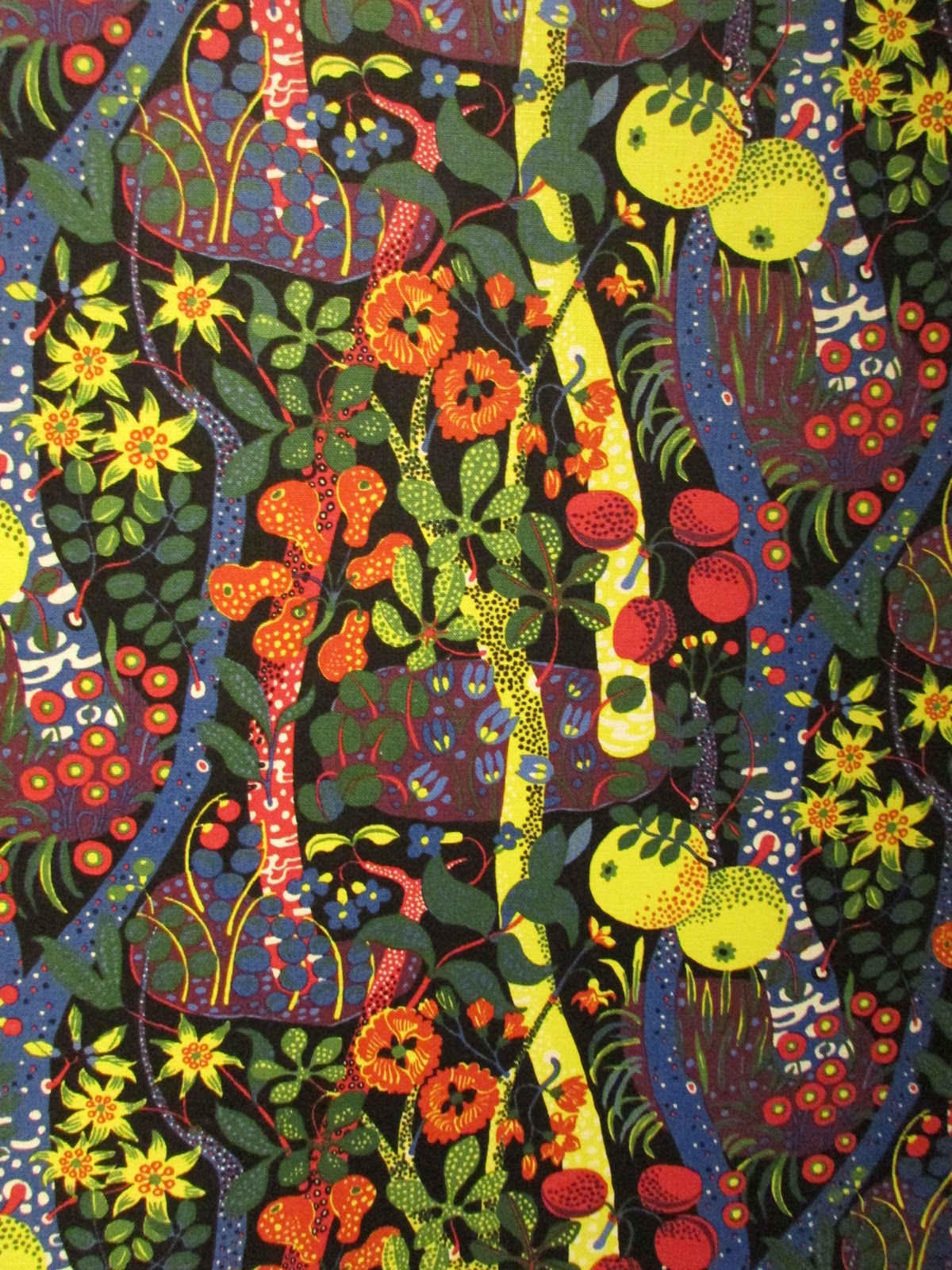


The little isolated details of Frank's designs are so delightful, and so rich in detail that you can see how they could easily spawn new textile designs of their own.


Grrrr!... Loved and coveted this fun rug. So playful!


Seeing the original artwork and being able to compare colours etc. to the finish printed product designs is always useful. Most designs were adapted to fabric with minimal adjustments.


The design above (like the Tulips design seen earlier ),is unusual as it is based on observations of real plants whereas many of his other designs were based on illustrations that Frank had adapted from children's illustrated books.


Frank's watercolour paintings - created purely for his own enjoyment after his textile design career began to wane - were a bit pedestrian to my eyes, and lack the spark and excitement of the textile designs. I would have liked him to apply some of the whimsy and playfulness of the textiles to these watercolours in perhaps the way Paul Klee did, to create something with a little more liveliness. Frank was aware however of the limitations of his watercolour technique and, (more power to his elbow), actually revelled in this. No matter what anybody thinks of them though, the act of painting undoubtedly made him happy, which is what matters most in the end - doing something creative which gives one pleasure and makes the heart sing.


The exhibition closes with a look at some William Morris textiles which were an influence on Frank's own style, and the legacy left on modern Swedish textiles by Josef Frank with contemporary designs from companies like Ikea. 


Josef Frank: Patterns-Furniture-Painting is a really enjoyable exhibition and well worth a visit for anybody with an interest in surface pattern design.


Josef Frank: Patterns-Furniture-Painting
until 7th May
Fashion and Textile Museum
83 Bermondsey Street
London
SE1 3XF
www.ftmlondon.org


Friday, 7 April 2017

Cerith Wyn Evans: Tate Britain Commission 2017


Cerith Wyn Evans' spectacular installation - Forms In Space...by Light (In Time)


Cerith Wyn Evans: Forms In Space...by Light (In Time)
until 20th August 2017
Tate Britain
Millbank 
London 


Tuesday, 4 April 2017

Issue & Impulse: Recent Commissions


Two recently commissioned pieces - Issue and Impulse - for clients with the most beautiful, big, thatched house out in the shires. 


The brief was to create two pieces which related to each other containing the colours black, white and gold. I based the finished pieces on the circular/spiral embroidery of the cushions in the window seat. 


It was an absolute pleasure to create these two pieces. They complement the textured gold wallpaper beautifully. Contact me direct, or via the galleries here if you would like to commission a piece from me.


Saturday, 1 April 2017

Butterflies In Britain: Richard Chopping


In the last post I shared some of my favourites books from the Puffin Book Club which is celebrating its 50th anniversay. One of the earliest Puffin books produced in the Puffin series was this paperback - Butterflies In Britain. Puffin was the brainchild and partnership of publisher Allen Lane (Penguin Books), and editor Noel Carrington, and this book from the Puffin series focuses of course on the butterfly species which occur naturally in these isles. 


The original Puffin series were produced during WWII despite the privations of that era, and their aim was to provide well illustrated educational literature that explained to children the natural world and built environment without talking down to them. Among the topics to be included were history, nature and geography, and all for the grand sum of sixpence!


Carrington looked to the great posters being produced by London Underground for illustrators to create imagery for the series, and decided that the most cost effective method of illustrating the titles was to use autolithography, which would involve the artists making their illustrations by drawing directly onto a zinc plate. 

 Pere Castor book illustration


This technique had been used by Soviet publishers to produce colourful books such as those in the Pere Castor series for Russian children, and was also used by artist Kathleen Hale to create the first of her highly successful Orlando The Marmalade Cat series for Puffin, which proved to be hugely successful. 


The Puffin series went on to be so popular that their use moved from the home to educational material in schools and colleges across the country. Butterflies In Britain was illustrated by Richard Chopping (1917-2008), a very close friend of the painter Francis Bacon. Chopping studied drawing flora and fauna under Cedric Morris at the East Anglian School of Painting and Drawing, and as well as being an illustrator from 1942-1949, taught at the Royal College of Art from 1965. He considered himself more an author than an artist and did write several books for children and adults.


Chopping is probably most well known for his much admired classic dust-jacket illustrations for Ian Fleming's James Bond series. His style of illustration was colourful and almost trompe l'eoil and he was chosen to illustrate the Bond books by Fleming's wife. He enjoyed depicting natural objects like plants and insects wherever possible in his work, so it is no great stretch of the imagination to see why he would be chosen to illustrate Butterflies In Britain


Chopping was only 25 years of age when when he was commissioned to both write and illustrate the Butterflies In Britain Puffin title having been introduced to Noel Carrington by Kathleen Hale. 


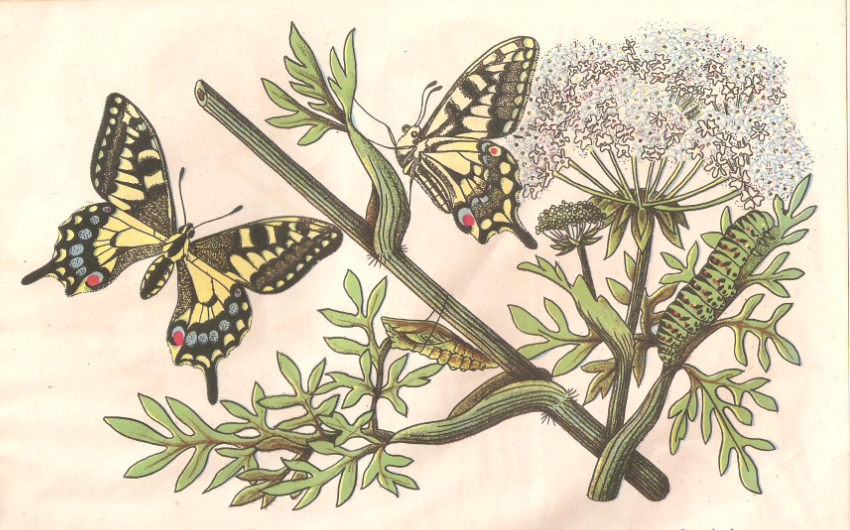
Chopping's drawing style is so accurate and descriptive in evoking the plants and butterflies, and also very sensitive to the subject matter and the lithographic printmaking technique. The illustration above is really effective at showing the subtle textures and sharp lines which could be achieved with lithography. This illustration also demonstrates how rich and vivid the density of colours could be in the finished artwork with the litho-print technique.


Butterflies in Britain is quite rightly regarded as one of the best of the early Puffin series and Chopping went on to be commissioned to create the illustrations for a series on British Wild Flowers. Unfortunately this proved to be an undertaking which proved too time consuming and costly so the project was abandoned. Butterflies In Britain is though, a real testament to Chopping's skill as an artist, and displays his natural sensitivity to the subject matter. Copies can still be found fairly cheaply in second hand bookshops and of course the internet.