Earlier this year as storms Denis and Ciara were doing their worst in Britain, I took off for a return to the beautiful Austrian capital city of Vienna. I was previously there 3 years ago (here), and had packed much in during my visit, but found there was much unfinished business. I had been greatly impressed by the work of architect Otto Wagner (1841-1918), which was much in evidence throughout the city, (previously here), so on this occasion top of my agenda was to examine first-hand what is generally regarded by architectural critics to be the first modernist church in Europe, and the magnum opus of his oeuvre - Kirche am Steinhof/The Church of St Leopold. Whilst Britain endured the wrath of the storms, I arrived in Vienna on the most beautiful, unseasonably warm, sunny, winter day. I made my way west to the Penzing district on the outskirts of the city. Kirche am Steinhof is situated there high on a hillside, its golden verdigris dome, gleaming in the winter sunlight becoming more conspicuous the nearer we approached. We were deposited at the bottom of the hill where the church is set within the grounds of the Steinhof Psychiatric Hospital asylum complex (now known as Otto Wagner Spital), and surrounded by a calming pine forest containing a variety of walking trails. To get to the church I walked through the manicured grounds and the complex of buildings and scaled the hill (Baumgartnerhöhe). I was rewarded for my efforts with not only the sight of the magnificent church, but panoramic views across Vienna and the surrounding countryside.

The main hospital building of the complex.

Kirche am Steinhof/Church of St Leopold
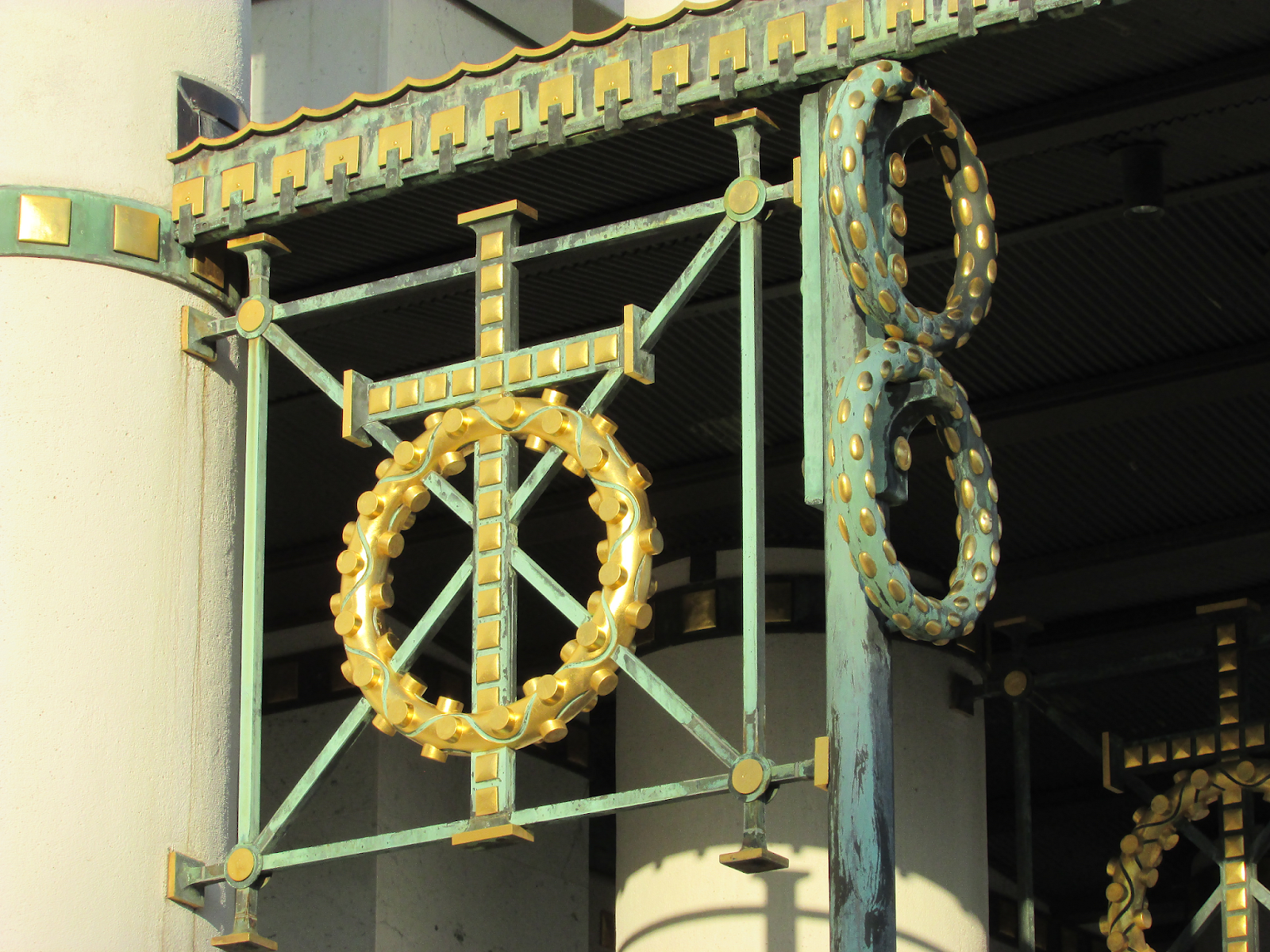
The church was designed and constructed by Wagner with regard to the wellbeing and needs of the psychiatric inmates of the complex. Many such asylums at the time were solely to keep the patients away from the public and resembled jails. At the turn of the century Vienna Sigmund Freud and his theories of psychoanalysis were instrumental in changing attitudes towards the mentally ill. Architects like Wagner believed that architecture could contribute to the cure of such patients, and the church was constructed after close consultation with doctors and nurses with regard to the needs of the patients within such institutions. Certain features such as few sharp edges as possible, emergency exits to facilitate the rapid removal of patients undergoing a crisis, and pews of differing widths to accomodate the physical conditions of the patients were integrated into the design of the church by Wagner. Kirche am Steinhof is now rightly acknowledged as a masterpiece, but as beautiful as the church and complex are, it was not without its critics and a partially very dark history. Archduke Ferdinand who opened the church in 1907, was a critic of Wagner's style and of Art Nouveau architecture in general refused to acknowledge Wagner at the opening ceremony, or commission any other architectural work from him. Jugendstil - the Viennese version of art nouveau was ridiculed in a Vienna that preferred its architecure to be staid and Neo-classical. One architectural critic of the time wryly asked: "And is it not a beautiful irony of fate, that the first sensible secessionist building in Vienna has been built for the insane?" During the 1930s and '40s the church and complex were taken over by the Nazis who sadly used the Steinhof Psychiatric Hospital facilities for their despicable medical experiments on the patients, murdering many of them in the process. The church built between 1903 and 1907, however, is a 'gesamtkunstwerk' (total work of art), employing the use of many disciplines of art by Wagner and his Seccessionist contemporaries in the Wiener Werkstätte. The facade consists of exposed stone boulders at the base, and then swathes of white marble left largely blank, but punctuated with motifs which became symbolic of Wagner's architectural style and works, such as surfaces studded with circular and square ornamental elements. Wagner also designed the altars, light fittings, pews and even the clerical robes and religious paraphernalia such as chalices etc. for the priests.


St Leopold

St Severin
The two towers crowning the front of the building are topped by statues of Saint Leopold on the left, and Saint Severin on the right, who are the patron saints of Austria, and are the work of Viennese sculptor Richard Luksch (1872–1936). The strikingly gorgeous column angels, shining radiantly on the main portal at the front of the church are the work of Othmar Schimkowitz (1864–1947), an architectural sculptor who was also commissioned by Wagner to design the sculptural figures for the facades of other significant Art Nouveau era buildings in Vienna.


An Othmar Schimkowitz angel
 Wagner's signature gilded ornamentation on the facade.


Details on the main entrance portal.

Having admired, and been suitably impressed by the exterior, I paid the the €5 entrance fee and made my way into the church. It is a compact, light, ethereal space, in a classic, dreamy, white/gold combination colour scheme. The restful interior with vaulting curves and ceiling was designed to avoid triggering anxieties in the patients. The hanging globe chandeliers and four narrow stained glass windows set into the ceiling representing the four apostles also add to the sense of light and spirituality in the church.


Stained glass skylights representing the four apostles.


The golden dome above the altar is mesmerising and echoes the gilded, copper dome capping the church outside. Wagner designed the altar, and Schimkowitz who designed the angel statues outside also created the host of angels encircling the golden dome which crowns the altar.


The Koloman Moser designed mosaics behind the focal-point altar are a glittering triumph of colour and pattern. The mosaic represents the departed souls entering heaven, and rather fittingly given the church's setting and purpose within the hospital complex, includes the figures of Saint Dymphna - the patron saint of those afflicted by epilepsy and mental illness. The sense of movement evoked in the lower nightscape section of the mural featuring these shimmering stars reminded me of Van Gogh's Starry Night Arles (1888).


Koloman Moser also designed the spectacular large stained glass windows situated on the left and right walls of Kirche am Steinhof. The stained glass windows fit seamlessly into the general decorative scheme of the church and add to the sense of the building being an harmonious gesamtkunstwerk. The windows each depict seven saints fulfilling Christ's commands that the hungry be fed, the naked clothed etc. Contained in each arch above the saints are yet more angels and quotations from the Beatitudes. These windows alone at a recent restoration were valued at being worth 5 million Euros. I felt really fortunate to have experienced the beauty of this church and its grounds on such an unseasonable though wonderfully sunny day. Kirche am Steinhof deserves all the plaudits bestowed on it, it is a real masterpiece. On a future visit when better kitted out, I would like to go on to explore one of the walking trails through the surrounding pine forests.


Wagner-designed lighting.

A smaller altar and decorative mosaic.

Steinhof Church
(Kirche am Steinhof)
Baumgartner Höhe 11140 Wien
Austria